Pediatric Regenerative Medicine: Questions Parents Should Ask Before Treatment
When parents are exploring regenerative medicine for a child, the most important question is not simply what treatment is available. It is whether the child’s case has been carefully evaluated, where the procedure will take place, who will be present, and what medical support will be available.
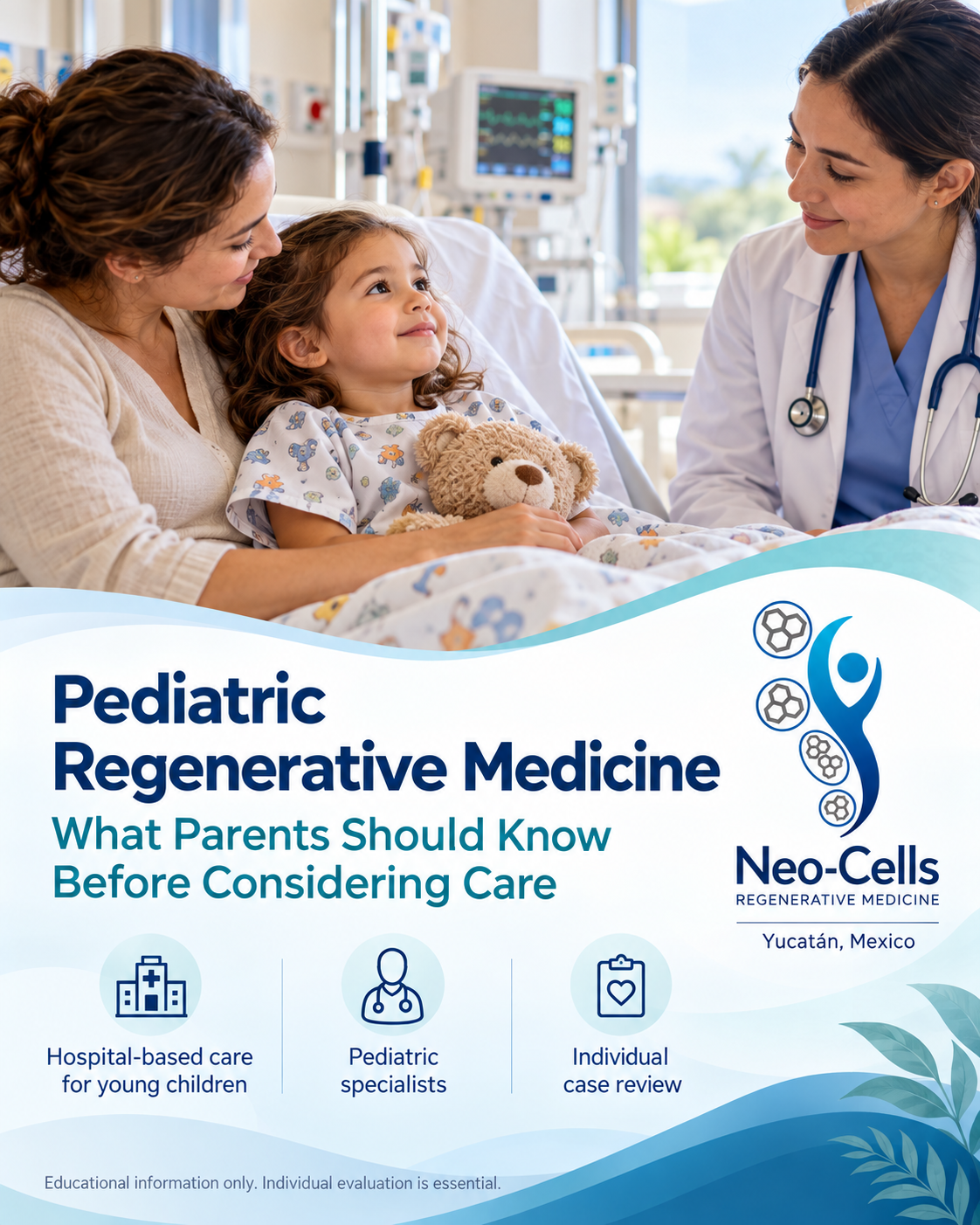
Pediatric Regenerative Medicine: What Parents Should Know Before Considering Care
When the patient is your child, the questions are different.
Parents exploring regenerative medicine for a child living with a neurological or neurodegenerative condition are often looking for something very specific:
Clear information.
A careful medical review.
The right specialists involved.
And confidence that their child will be cared for in the right setting.
At Neo-Cells, young children are not treated at our clinic.
When a pediatric case is accepted and a procedure is considered appropriate, the procedure is performed in a hospital setting, where the medical team has access to the infrastructure needed for pediatric care and can respond if additional support is required.
That is an important distinction.
Children are not simply smaller adults. Their medical needs, monitoring requirements, medication considerations, recovery needs, and ability to communicate symptoms can be very different.
For that reason, pediatric care requires a different level of planning.
Why the Care Setting Matters
Parents understandably want to know what treatment is being proposed.
But where the procedure will take place matters too.
A hospital setting provides access to broader medical resources, monitoring, recovery support, and emergency capabilities if they are needed.
For young children, that added level of preparation can be especially important.
At Neo-Cells, pediatric cases are handled with that in mind.
The goal is not simply to perform a procedure.
The goal is to make sure the child is being cared for in an environment appropriate for pediatric medical needs.
Why Pediatric Specialists Are Involved
Pediatric cases involve qualified pediatric specialists as part of the medical team, together with the physicians responsible for reviewing the child’s condition and any proposed treatment.
That matters because a pediatric specialist considers more than the diagnosis itself.
They may look at:
- Age and development
- Weight
- Current medications
- Previous procedures
- Other medical conditions
- Previous reactions to medications or anesthesia
- Monitoring needs
- Recovery needs
For a child with a more complex medical history, these details can be especially important.
The medical team needs to understand the whole child—not only the condition listed in the medical record.
The First Step Is a Careful Case Review
Parents should not feel that they need to know which treatment they want before speaking with the medical team.
That is not the starting point.
The starting point is understanding the child’s medical history.
A proper review may include:
- The child’s diagnosis
- When symptoms began
- How the condition has changed over time
- Current medications
- Previous treatments or therapies
- Hospital records
- Imaging
- Neurological evaluations
- Other relevant specialist reports
This information helps the medical team decide whether further evaluation makes sense.
Not every child is a candidate for regenerative medicine.
Not every condition should be approached the same way.
And not every family who contacts Neo-Cells will be advised to proceed.
That is what individualized medical review is for.
What Parents Should Ask Before Moving Forward
If you are considering regenerative medicine for your child, there are a few questions that are especially important.
Where will the procedure be performed?
Ask whether it will take place in a clinic or hospital.
For young children, this can make a meaningful difference in the level of medical support available.
At Neo-Cells, young children’s procedures are performed in a hospital setting.
Is a pediatric specialist involved?
Parents should know whether a qualified pediatric specialist is actually part of the child’s care.
This is different from simply having someone available if a problem occurs.
The pediatric specialist should be involved in the medical planning and care of the child.
What monitoring will be available?
Ask what happens during and after the procedure.
Parents deserve to know:
- How the child will be monitored
- Who is responsible for that monitoring
- Where recovery will take place
- What happens if additional medical support is needed
These are reasonable questions.
A medical team should be able to answer them clearly.
Has my child’s individual medical history been reviewed?
This may be the most important question of all.
A treatment should not be recommended simply because a child has a particular diagnosis.
The medical team should understand the child’s overall health, previous treatments, current medications, medical records, and any other conditions that may affect care.
The child’s individual situation should guide the conversation.
What Parents Should Understand About Regenerative Medicine
Regenerative medicine is an evolving field.
There is real scientific interest in cell-based and biologic approaches for a number of neurological and neurodegenerative conditions.
At the same time, the amount and quality of evidence varies depending on the condition, the type of therapy, and the individual patient.
That means parents should be cautious about any provider that makes broad promises.
Be careful with claims such as:
- “This works for every child.”
- “This will cure the condition.”
- “There are no risks.”
- “Your child is definitely a candidate.”
- “You need to decide immediately.”
A responsible medical conversation should include both what is known and what is still uncertain.
Parents should be given time to ask questions.
They should understand the proposed approach.
And they should understand why the medical team believes it may—or may not—be appropriate for their child.
What If You Are Traveling to Mexico?
For families traveling from another country, planning becomes even more important.
Before making travel arrangements, it is helpful to understand:
- Which medical records are needed
- Whether the medical team can review the case in advance
- Where the procedure would take place
- Which specialists would be involved
- How long the child may need to remain locally
- What follow-up is expected
- Who the family should contact after returning home
Parents should not feel that they need to travel first and ask questions later.
A meaningful medical review should happen before any treatment decision is made.
A Good Medical Conversation Should Make Things Clearer
Parents exploring regenerative medicine are often already carrying a great deal of uncertainty.
They may be comparing options.
They may be researching treatments late at night.
They may be hearing different advice from different sources.
The medical team should make that process easier to understand—not more confusing.
A good consultation should help answer:
- What does the medical team understand about my child’s condition?
- Is further evaluation appropriate?
- Is regenerative medicine something worth discussing?
- Where would the procedure take place?
- Who would be involved?
- What should we realistically expect?
- What are the next steps?
The goal is clarity.
Not pressure.
Frequently Asked Questions
Does Neo-Cells treat young children at the clinic?
No. Young children are not treated at the Neo-Cells clinic.
When a pediatric procedure is considered appropriate, it is performed in a hospital setting.
Are pediatric specialists involved?
Yes.
Pediatric cases involve qualified pediatric specialists as part of the medical team.
Does a neurological diagnosis automatically make a child a candidate?
No.
Each child must be reviewed individually.
The diagnosis alone is not enough to determine whether regenerative medicine may be appropriate.
Do parents need to decide on a treatment before contacting Neo-Cells?
No.
The first step is to allow the medical team to review the child’s case and relevant records.
What records should families prepare?
Depending on the child’s situation, useful records may include:
- Neurology reports
- Imaging
- Hospital records
- Medication lists
- Previous treatment records
- Specialist evaluations
- Relevant laboratory studies
The care team can help clarify what is needed.
The Most Important Takeaway
For parents, the most important question is not:
“What treatment is available?”
It is:
“Has my child been carefully evaluated, and is this care being provided in the right medical setting with the right specialists involved?”
At Neo-Cells, pediatric cases begin with individual review, appropriate medical oversight, and clear communication with the family.
Not every child is a candidate.
Not every condition is approached the same way.
And every family deserves a clear explanation before any decision is made.
Request a Pediatric Case Review
If your child is living with a neurological or neurodegenerative condition and you would like the medical team to review the case, you can contact Neo-Cells directly.
Email: info@neo-cells.com
Phone / WhatsApp: +52 999 409 2996
Neo-Cells Regenerative Medicine
Yucatán, Mexico
Educational information only. Pediatric regenerative medicine requires individualized medical evaluation. Not every child or condition is appropriate for treatment, and individual results may vary.
Ask questions before you decide
This article is educational only and is not medical advice. The care team can help you understand what to ask before planning treatment or travel.
Contact the care team