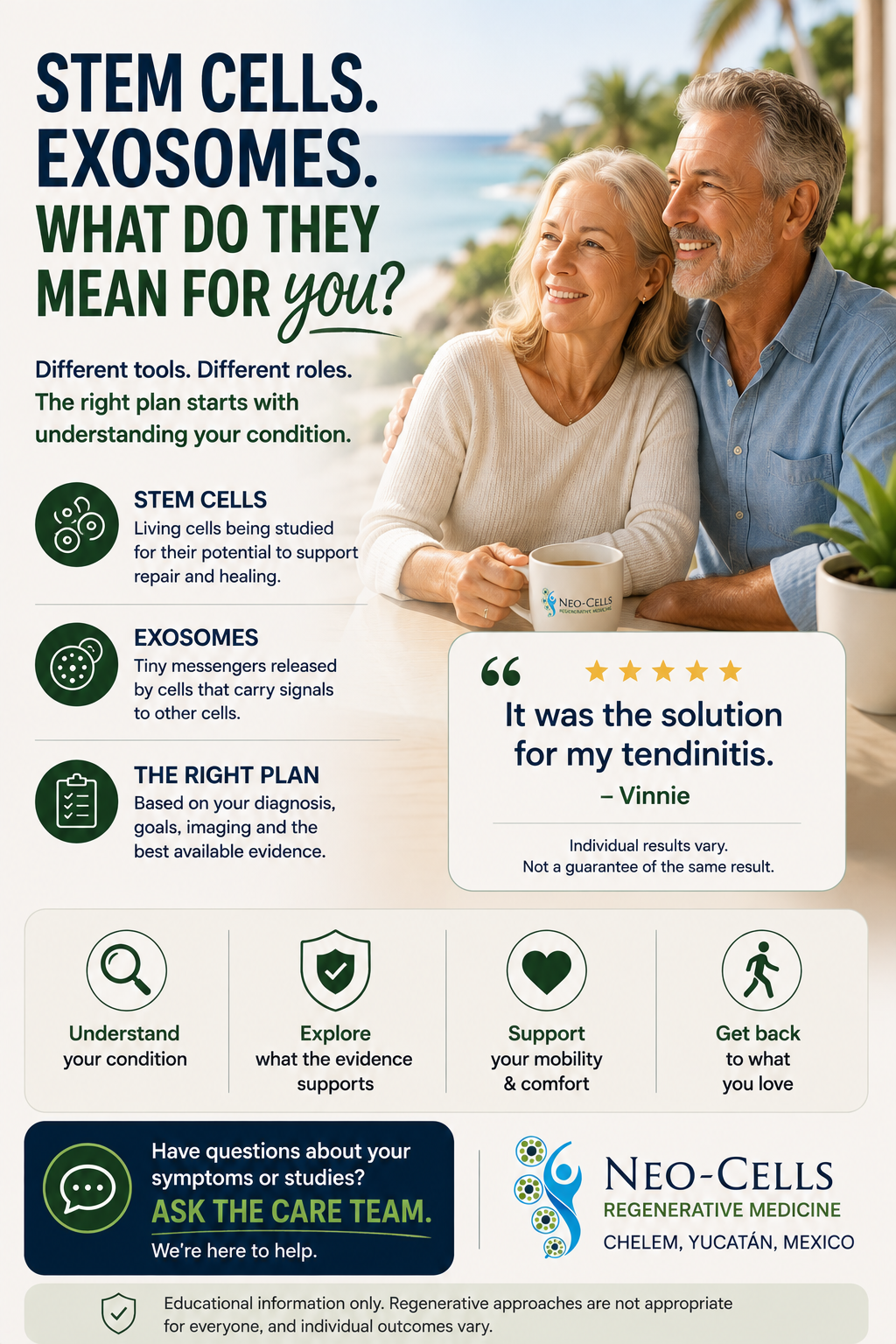
Stem Cells vs. Exosomes: What Patients Should Know About Regenerative Medicine
A simple guide to stem cells and exosomes for adults with joint or tendon pain. Learn what they are, why they are being studied, and why your diagnosis matters before considering regenerative medicine.
You may have heard the words stem cells and exosomes while searching for answers about knee pain, shoulder problems, tendon injuries, or arthritis.
Maybe a friend mentioned them.
Maybe you saw an advertisement.
Maybe you came across a video online that made them sound like the answer to everything.
And that can leave you with more questions than answers.
Are stem cells and exosomes the same thing?
Do they actually help?
Could they be appropriate for your knee, shoulder, hip, or tendon problem?
And how do you know what information to trust?
At Neo-Cells Regenerative Medicine, Dr. Esparza believes patients should understand the basics before making any decision.
You do not need a medical degree.
You just need clear information.
First, Why Are People Interested in Regenerative Medicine?
For many adults in their 50s, 60s, and 70s, the issue is not simply “pain.”
It is what pain begins to change.
Maybe you stop walking as far as you used to.
You think twice before taking a trip.
Gardening becomes more difficult.
You avoid stairs when you can.
A shoulder problem makes sleeping uncomfortable.
A knee problem makes golf, pickleball, or long walks less enjoyable.
Over time, even small changes can begin to affect independence and confidence.
That is why regenerative medicine has attracted so much attention.
The goal of this field is to study ways of supporting the body’s own repair and recovery processes in certain conditions.
Stem cells and exosomes are two areas being studied within that larger field.
But they are not the same thing.
What Are Stem Cells?
In simple terms, stem cells are living cells.
Certain types of stem or stromal cells are being studied because of the way they interact with injured or inflamed tissues.
Researchers are especially interested in the signals these cells may release and how those signals may influence inflammation, healing, and tissue recovery.
That does not mean stem cells automatically rebuild damaged cartilage or restore a worn joint.
That is an important distinction.
For example, some research in knee osteoarthritis has reported improvements in pain and function in certain patients.
But results are not the same for everyone.
Different studies use different types of cells, different preparation methods, and different patient groups.
So the science is more complicated than:
“Stem cells fix arthritis.”
They do not work like a replacement part.
They are better understood as part of an evolving area of regenerative medicine that may be appropriate in selected cases.
What Are Exosomes?
Exosomes are not cells.
They are much smaller.
A simple way to think about them is as tiny messengers.
Cells naturally communicate with one another. Exosomes are one way they can send information.
These microscopic particles can carry signals from one cell to another.
Researchers are studying whether those signals may play a role in inflammation, tissue repair, and recovery.
That is why exosomes have become an interesting area of regenerative medicine research.
But exosome research is still developing.
There is growing scientific interest, but the amount of strong human evidence is still more limited than many advertisements may suggest.
So when someone says “stem cells and exosomes” as if they are the same thing, it is worth knowing that they are actually quite different.
Why Does the Difference Matter to You?
Because the real question is not:
“Which one sounds more advanced?”
The better question is:
“What is actually causing my problem?”
Imagine two people with knee pain.
One person has mild osteoarthritis and discomfort after walking.
Another has advanced joint damage, instability, and significant changes on imaging.
They both have “knee pain.”
But they do not necessarily have the same problem.
And they should not automatically receive the same recommendation.
The same is true for shoulder pain.
A painful shoulder may involve a tendon, the joint, a bursa, the rotator cuff, or even the neck.
A person may simply say:
“My shoulder hurts.”
But that does not tell the whole story.
This is why Dr. Esparza begins with the diagnosis—not with the product.
Before Talking About Treatment, Understand the Problem
A personalized evaluation may include:
- Where the pain is located
- How long it has been present
- Which movements make it worse
- Whether there is weakness or stiffness
- Previous injuries
- Treatments already tried
- Available X-rays, MRI scans, or other studies
- What activities you want to continue doing
That last point matters.
For one person, the goal may be walking comfortably through the airport.
For another, it may be getting back to gardening.
Someone else may simply want to climb stairs, sleep better, or spend a full day with family without thinking constantly about the painful joint.
Those goals help shape the conversation.
What About Knee Osteoarthritis?
Knee osteoarthritis is one of the conditions most commonly discussed in regenerative medicine.
Many people think osteoarthritis simply means that the cartilage has “worn out.”
But the knee is more complex than that.
Pain can be influenced by changes in cartilage, bone, inflammation, muscle strength, joint mechanics, and surrounding tissues.
Research has looked at whether stem-cell-based approaches may help support pain and function in certain people with knee osteoarthritis.
Some studies have shown encouraging results.
But there is still no single answer that applies to everyone.
Age, severity of arthritis, alignment of the joint, overall health, activity level, and other factors all matter.
That is why a treatment should never be chosen based only on the words:
“I have arthritis.”
What About Tendon Problems?
Tendon pain is another common reason adults begin looking into regenerative medicine.
Examples include:
- Rotator cuff problems in the shoulder
- Tennis elbow
- Achilles tendon concerns
- Tendon pain around the hip or knee
Tendons can become irritated, weakened, or damaged over time.
Sometimes the problem develops gradually.
You may first notice discomfort when lifting something overhead.
Or when carrying groceries.
Or after gardening.
Or when swinging a golf club.
Over time, those small limitations can begin to affect daily life.
Research is exploring regenerative approaches for certain tendon problems, but again, the exact diagnosis matters.
Not every sore tendon has the same problem.
And not every tendon problem needs the same treatment.
One Patient’s Experience
One Neo-Cells patient, Vinnie, shared:
“It was the solution for my tendinitis.”
Individual results vary.
So How Do You Know If Regenerative Medicine May Be Appropriate?
You do not have to figure that out on your own.
And you do not have to choose between stem cells, exosomes, or any other option before speaking with a doctor.
A better first step is to understand:
What is causing the pain?
How advanced is the problem?
What have you already tried?
What does the available research suggest for your condition?
What are you hoping to get back to doing?
Once those questions are clear, the treatment conversation becomes much easier to understand.
What Should You Be Cautious About?
Regenerative medicine is an evolving field.
That means there is real research happening.
It also means there are still unanswered questions.
Be cautious of claims that promise:
- Guaranteed results
- Complete cartilage regrowth
- Permanent healing
- A cure for arthritis
- The same outcome for every patient
A trustworthy medical conversation should include both what is known and what is still uncertain.
You should feel comfortable asking questions.
And you should understand why a particular option is being discussed for your situation.
The Goal Is Not Just Less Pain
For many patients, pain relief is important.
But it is usually not the whole story.
What people really want is to keep living normally.
They want to:
Walk without planning every step.
Travel without worrying about how far they will have to walk.
Enjoy the beach.
Work in the garden.
Play golf or pickleball.
Spend time with family.
Remain independent.
That is why the medical decision should always connect back to the life you want to keep living.
What Dr. Esparza Looks at Before Making a Recommendation
At Neo-Cells, Dr. Esparza begins with a personalized evaluation.
That may include reviewing:
- Your symptoms
- Your health history
- Your imaging or previous studies
- Your current mobility
- Your previous treatments
- Your daily activities
- Your personal goals
In some cases, additional diagnostic tools may be helpful.
In others, the information already available may be enough to begin discussing next steps.
The point is not to force every patient into the same treatment plan.
It is to understand the individual first.
Frequently Asked Questions
Are stem cells and exosomes the same thing?
No.
Stem cells are living cells.
Exosomes are tiny particles released by cells that carry biological signals.
They are different, even though they are often discussed together.
Can stem cells regrow my cartilage?
Current evidence does not support promising that a stem-cell procedure will reliably regrow cartilage or return an arthritic joint to normal.
Some studies suggest potential benefits in pain or function for certain patients, but results vary.
Are exosomes proven?
Exosomes are an active area of research.
Much of the evidence is still emerging, particularly when it comes to large, high-quality human studies.
Does everyone with arthritis qualify?
No.
The appropriate approach depends on the diagnosis, severity of the condition, your health, your goals, and other clinical factors.
What should I bring to a consultation?
If you have them, bring previous X-rays, MRI reports, ultrasound studies, medical records, and a list of treatments you have already tried.
It also helps to think about what activities you most want to continue doing.
The Most Important Thing to Remember
Stem cells and exosomes are interesting areas of regenerative medicine.
But the most important thing is not knowing which one sounds better.
It is understanding your condition.
Once you know what may be causing the pain, the conversation becomes much clearer.
Then you can discuss what the evidence suggests, what options may be appropriate, and what realistic goals make sense for you.
For many people, that goal is simple:
Stay mobile. Stay independent. Keep doing the things that make life enjoyable.
Have Questions About Stem Cells, Exosomes, or Your Joint or Tendon Pain?
You do not need to know which treatment you want before reaching out.
If you have symptoms, imaging, a diagnosis, or questions about regenerative medicine, start by speaking with the care team.
Ask the Care Team
Or, if you would like Dr. Esparza to review your situation personally:
Request a Private Consultation
Neo-Cells Regenerative Medicine
Chelem • Yucatán • Mexico
This article is for educational purposes only and does not replace medical advice or individualized care. Regenerative approaches are not appropriate for everyone. Individual results vary.
Get Clear Answers About Your Options
Ask questions before you decide
This article is educational only and is not medical advice. The care team can help you understand what to ask before planning treatment or travel.
Contact the care team